Woude, Johanna van |
| AUTHOR, MAGAZINE EDITOR (NETHERLANDS) |
|
BORN 23 Nov 1853, Tiel, Gelderland - DIED 26 Nov 1904, Utrecht, Utrecht BIRTH NAME Junius, Sophie Margaretha Cornelia GRAVE LOCATION Utrecht, Utrecht: 2e Begraafplaats Kovelswade, Koningsweg (22-0-169) |
|
Johanna van Woude was born as Sophia Junius. Her father was the minister Franciscus Junius (1809-1879) and her mother was born Anna Marie Titia Burhoven Viëtor (1810-1879). She was the ninth daughter of ten children. Her father was the author of several publications and her sister Francisca (1847-1890, known as Annie Foore) published her first novel "Florence's Droom" ("Florence's Dream") in 1872. In 1874 Sophie published her first short story under the pseudonym Bella. Her first novel "Hare roeping trouw" ("Faithful Calling") was well received in 1879. This time she used the name Johanna van Woude, matching the initials of her fiancée Johannes van Wermeskerken (1847-1918). She married him on 9 December 1880 in Rotterdam. They had two sons, Henri in 1882 and Maus in 1885. She concentrated on her family, but she continued to write as well and provided the main income for the family for a number of years. In 1888 her best known novel "Hollandsch binnenhuisje" ("A Dutch House") was published, followed by Tom en ik" ("Tom and I") in 1889. Women mostly read her work, but critics often considered it too well-behaved and conservative. In 1889 she became editor-in-chief of "De Hollandsche Lelie", a magazine for young women founded by Catharina Alberdingk Thijm. Initially she stressed in her editorial writings that marriage should be the aspiration of every woman, but later she paid more attention to education and job opportunities for women. In 1893 she was one of the first women to join the Maatschappij der Nederlandse Letterkunde. In 1892 her husband was appointed as a notary and the family moved to Krommenie. But the marriage deteriorated quickly and she left her husband for boarding houses. In 1893 she asked for a divorce because he had abused her. In 1895 she returned to Krommenie, but on 5 November her husband filed a complaint that she had tried to poison him with antipyrine and she was arrested. She was imprisoned for several weeks in Haarlem and she was interrogated. She was released because the evidence was insufficient and the dose had not been lethal. On 11 January 1898 she separated legally from her husband and the divorce followed on 7 May 1901. By that time her health was deteriorating quickly and her behavior became erratic. On 6 June 1902 she was sent to the Medical Asylum for the Insane in Utrecht. It is possible that she suffered from dementia paralytica caused by syphilis. It did not prevent her from working on a new novel, but she died in 1904. She was buried at the Soestbergen cemetery in Utrecht. In 1915 she was reburied at the Kovelswade cemetery in Utrecht, where a monument was commissioned by her son, the journalist and writer Henri van Wermeskerken (1882-1937), in 1934. It incorrectly states that she died in 1905. |
| Images |
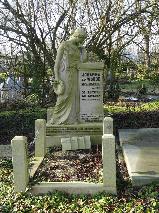 The grave of Johanna van Woude at the Kovelswade cemetery in Utrecht. Picture by Androom (17 Jan 2026) |


