Bonaparte, Pauline

NOBLEMAN (FRANCE)
BORN 20 Oct 1780, Ajaccio, Corse-du-Sud - DIED 9 Jun 1825, Firenze, Toscana: Villa Fabbricotti
BIRTH NAME Buonaparte, Maria Paola
CAUSE OF DEATH cancer
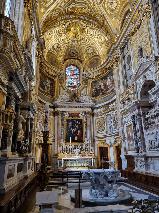
GRAVE LOCATION Roma, Lazio: Santa Maria Maggiore, Piazza di San Maria Maggiore (Borghese chapel)

Maria Paola Buonaparte was born eleven years after her brother Napoleon, the future emperor Napoleon I. She was known as Paoletta. Little is known about her youth but she had no formal education since the family was poor after her father Carlo's death in 1785. In 1793 the family had to flee to France after her brother Lucien had commented on the local Jacobins. In France she was called Paulette.

The family moved from Toulon to Marseilles, where Napoleon, by then a general, introduced her to Louis-Marie Stanislas Fréron. Fréron wanted to marry her, but her mother Laetitia objected. Although she loved Fréron, Napoleon made her marry General Charles Leclerc in Milan on 14 June 1797. In 1798 their son Dermide Louis Napoleon was born.

Leclerc was appointed governor of Saint-Domingue by Napoleon and in 1801 they sailed. There was a rebellion going on when they arrived and the climate was damaging Pauline's health. At the same time several of her husband's soldiers became her lovers. Leclerc fell ill in 1802 and died on 1 November, probably of yellow fever.

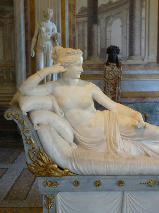
Pauline returned in France on 1 January 1803. On 28 August 1803 she married Camille Borghese, one of the richest men in Italy and the owner of the Villa Borghese in Rome. Her husband commissioned a statue of her by Antonio Canova. Canova was reluctant but after he swa her he agreed to the commission. To her husband's horror she decided to pose nude as Venus Victrix. When she was asked wether she was uncomfortable being naked, she answered that there was a fire in the room.

Soon she was disappointed in her marriage and she returned to taking lovers, among them Niccolò Paganini, the famous violinist. Her son Dermide died on 14 August 1804. In 1806 Napoleon made her Duchess of Guastalla, but she sold the duchy to Parma and only kept the title of Princess of Guastalla. There was tension with Napoleon when she showed her dislike of his second wife Marie Louise. But when Napoleon's power was fading they became closer again and in 1814 she visited him on Elba and supported him financially. Her house in Paris was sold to the British government and used by Wellington.

After Waterloo she moved to Rome, where she asked for the protection of Pope Pius VII. She immediately received it, although he had been the prisoner of her brother from 1809 to 1814. She lived near the Porta Pia in a villa called Villa Paolina. Camillo had a long term mistress and had moved to Florence to be far away from Pauline. She was seriously ill and after she appealed to the new Pope Leo XII, in 1825 he ordered Camillo to return to her. They live together until she died of cancer later that year, aged 44.

Family
• Husband: Borghese, Camillo, 6th Prince of Sulmona (1803-1825)

Related persons
• was painted by Lefèvre, Robert
• detested Marie Louise, Empress of France, Duchess of Parma
• was visited by Morgan, Sydney, Lady
• has a connection with Paganini, Niccolò
• had a love affair with Talma, François Joseph

Events
0/1/1797Maria Brizzi Giorgi performs at the Teatro Marsigli in Bologna for Napoleon. The performance was organised because of the visit of general Napoleon Bonaparte to Bologna. Napoleon, his wife Joséphine and his sister Pauline attended. [Beauharnais, Joséphine de][Brizzi Giorgi, Maria][Napoleon I Bonaparte]
26/4/1814Napoleon meets his sister Pauline at a farmhouse. Napoleon was on his route to exile and instead of following the advice to flee to Rome, Pauline had settled in a farmhouse where he would pass. In the afternoon of 26 April they met each other and embraced and held each other in public. After that they retreate to a private room to talk. Pauline followed him to Elba afterwards. [Napoleon I Bonaparte]
22/8/1814Wellington arrives in Paris as ambassador for the United Kingdon. The British government bought the Hôtel de Charost in de rue du Faburg St Honoré that had belonged to Pauline Bonaparte, Napoleon's sister. [Wellington, Arthur Wellesley, 1st Duke of]
26/2/1815Napoleon embarks at Portoferraio and leaves Elba. He had decided to return to France. People around it called it an insane undertaing. But the eagle's flight was to be muraculous and later on St. Helena Napoleon would declare that the march from Cannes to Paris that would follow was the happiest time of his life. It was the last time he saw his siter Pauline who had followed him to Elba. [Napoleon I Bonaparte]
3/3/1815Pauline Bonaparte leaves Elba. She was afraid she would be imprisoned by the Allied powers and she left Elba a few days after her brother Napoleon. She wanted to go to Italy and join Napoleon in France once it was safe to do so. She went to the house of her sister Elisa in Campignagno-Sol-Monte between Viareggio and Lucca. The night after her arrival Austrian guards arrived and she was effectively imprisoned. After several doctors confirmed her bad health she was allowed to leave for the waters at Bagni di Lucca. There she heard of Napoleon's defeat and second abdication. 

Images

Canova's statue of Pauline Bonaparte at the Villa Borghese, Rome.
Picture by Androom (27 Feb 2015)


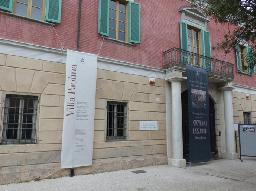
Via Paolina in Viareggio, the former summer house of Pauline Bonaparte.
Picture by Androom (16 Feb 2018)


The Borghese chapel in the Santa Maria Maggiore, Rome.
Picture by Androom (25 Apr 2023)


Sources
Die Grosse Dynastien, Südwest Verlag, München, 1978
• Fraser, Flora, Venus of Empire, The Life of Pauline Bonaparte, John Murray, London, 2009
• Longford, Elizabeth, Wellington, The Years of the Sword, World Books, London, 1971
• Vanoyeke, Violaine, Les Bonaparte, Criterion, Paris, 1991
Pauline Bonaparte - Wikipedia (EN)
Maria Brizzi Giorgi - Wikipedia (IT)


Bonaparte, Pierre Napoleon

Published: 26 Nov 2017
Last update: 06 Apr 2026