| Images |
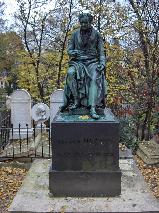 The grave of Vivant Denon at Père Lachaise, Paris. Picture by Androom (19 Nov 2006) |
Denon, Vivant |
| ART HISTORIAN, ARTIST, DIPLOMAT, ARCHAEOLOGIST (FRANCE) |
|
BORN 4 Jan 1747, Chalons-sur-Saône, Saône-et-Loire - DIED 27 Apr 1825, Paris: 10e Ancien BIRTH NAME Denon, Dominique Vivant, Baron Denon GRAVE LOCATION Paris: Père Lachaise, Rue du Repos 16 (division 10, chemin Denon, ligne 01 (M: Y 22)) |
|
Vivant Denont was a favourite of Louis XV, who let him collect medals and gems for madame de Pompadour. When Louis XVI succeeded was sent to Sweden, but he soon returned to French with De Vergennes, the ambassador in Sweden who now became foreign minister. When he was sent on a mission to Switserland he visited Voltaire at Ferney. His portrait of Voltaire was engraved and published in Paris. The next seven years his diplomatic career took him to Naples. Then De Vergennes died and he was recalled to France. He was without a diplomatic position now, entered the Academy of Painting, but soon returned to Italy. During the French revolution he went back to France after he heard that his property had been confiscated. He survived because of his friendship with the painter David. After the revolution he was among the frequent visitors of the house of Joséphine de Beauharnais. There he met Napoleon Bonaparte, whom he accompanied to Italy and Egypt. Napoleon made him director-general of the museums. In museums in occupied countries he selected famous works that were brought to Paris. After the restoration of 1815 he lost his job because he had supported Napoleon during the 100 Days. After his death his seat in the Académie dex Beaux-Arts was given to Ingres. His novel "Point de lendemain" (1777) was reprinted several times during the nineteenth century. Related persons • had work illustrated by Baltard, Pierre • visited Beauharnais, Joséphine de • was a friend of David, Jacques-Louis • was painted by Lefèvre, Robert • worked for Napoleon I Bonaparte • was painted by Ramberg, Johann Heinrich • visited Voltaire • drew Voltaire Events |
| 25/6/1825 | Ingres is elected into the Académie des Beaux Arts. He received one more vote than Horace Vernet and he replaced Vivant Denont, who had been general director of the French Museums. [Ingres, Jean Auguste Dominique][Vernet, Horace] |
| Images |
|
The grave of Vivant Denon at Père Lachaise, Paris. Picture by Androom (19 Nov 2006) |
Sources • Le Clère, Marcel, Cimetières & Sepultures de Paris, Hachette, Paris, 1978 • Winkler Prins Encyclopedie (editie 1909), 1909 • Dominique Vivant Denon — Wikipédia |


