Wesendonck, Mathilde |
| POET, WRITER, TRANSLATOR (GERMANY) |
|
BORN 23 Dec 1828, Elberfeld, Nordrhein-Westfalen (now: Wuppertal) - DIED 31 Aug 1902, Traunblick am Traunsee, Oberösterreich BIRTH NAME Luckemeyer, Agnes GRAVE LOCATION Bonn, Nordrhein-Westfalen: Alter Friedhof (Abteilung V, Grabnummer 105-108) |
|
Agnes Luckemayer was the daughter of the merchant Carl Luckemayer (1801-1875) from Elberfeld. She grew up in Wuppertal and in 1848 she married another merchant, Otto Wesendonck. At his request she changed her first name from Agnes into Mathilde. In 1850 they travlled to the USA and in 1851 they moved to Zurich. On 20 Jan 1852 they attented a concert conducted by Wagner, who had fled from Dresden in 1849. In 1853 Wagner became infatuated with Mathilde and he wrote a piano sonate for her. She certainly became his muse, but it's not clear if their relationship was also sexual. Mathilda was opposed against vivisection and under her influence Wagner developed an interest in the right of animals. Her house in Zurich was also visited by Franz Liszt as well as Hans and Cosima von Bülow. In 1857 Wagner moved into his "Asyl", a house in the garden of the Wesendonck villa. In 1857/1858 he composed his "Wesendonck Lieder" ("Wesendonck Songs"), based on five of her poems. He used these songs for "Tristan and Isolde". After Wagner's wife Minna intercepted a love letter to Mathilda on 7 apr 1858 they had to break off their liaison and he left the "Asyl" on 17 Aug 1858. In 1863 he wrote in a letter to Eliza Wille that Mathilda was his first and only love. Apart from writing poetry, Mathilda wrote children's books and also translated works into German. In 1871 the Wesendoncks had to leave Zurich, because they had celebrated the defeat of France by Prussia in 1870 explicitly, almost causing the local people to set their house on fire. They settled in Dresden in 1872 and moved on to Berlin in 1882. When their son Hans died in Bonn during his studies in 1882, they bought a family grave at the Alter Friedhof. Otto was buried there in 1896 and Mathilde followed him in 1902. Family • Husband: Wesendonck, Otto (1848-1896) Related persons • admired Brahms, Johannes • was sculpted by Küppers, Albert • had a relationship with Wagner, Richard |
| Images | |
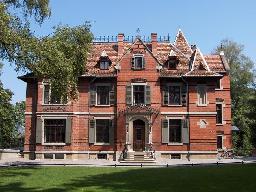 The Villa Schönberg stands at the spot of the former Riegelhaus (or "Asyl") where Richard Wagner lived and worked from 1857 to 1858. The Riegelhaus was owned by Otto and Mathilda Wesendonck who sold it in 1872. The present villa was built in 1882. Picture by Androom (18 Aug 2005) |
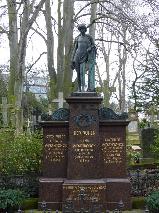 The grave of Otto and Mathilda Wesendonck at the Alter Friedhof, Bonn. Picture by Androom (17 Mar 2022) |
Sources • Villa Wahnfried (Wagner Museum), Bayreuth • Mathilde Wesendonck - Otto und Mathilde Wesendonck - WebSitePortal |


