Géricault, Théodore |
| PAINTER (FRANCE) |
|
BORN 26 Sep 1791, Rouen, Seine-Maritime - DIED 18 Jan 1824, Paris GRAVE LOCATION Paris: Père Lachaise, Rue du Repos 16 (division 12, avenue de la Chapelle, ligne 01 (Moiroux: W-18)) |
|
Théodore Géricault was born in Rouen. From his youth he was opposed to the way of classical painting. He was taught at the École des Beaux-Arts by Carle Vernet and by P.N. Gúerin. The latter appreciated his talent but disliked his fiery temper. Eugène Delacroix was one of his classmates. At the Louvre he copied the old masters and "The Charging Chasseur" (1812) was influenced by the style of Rubens. After the Bourbon restoration of 1815 he entered the Royal Horseguards for a while to find inspiration for war paintings. He had started an affair with Alexandrine-Modeste Caruel, the young wife of his uncle Jean-Baptiste Caruel de Saint-Martin, baron de Favreuse (1757-1847). She was only six years his senior. In 1817 he travelled to Italy but after his return Alexandrine-Modeste gave birth to his son Georges-Hippolyte. About that time he created his most famous work, "Le Radeau de la Méduse" ("The Raft of the Medusa", 1819, The Louvre, Paris). It was about a French shipwreck where the captain had left the passengers to die. It also depicted the struggle of man against nature. Eugène Delacroix was the model for one of the dying people. The painting caused controversy in France 1819 but it was praised in England, where in was shown in 1820. His family had extracted a promise from him and Alexandrine-Modeste that they wouldn't see each other no more and they obliged. Alexandrine-Modeste lived at the castle of Le Chesnay until her death in 1875. Her son by Géricault was raised by strangers and she never saw him again. Paul Caruel de Saint-Martin, her son by her husband, became a politician and was mayor of Chesnay. Géricault went to London in April, 1820 and lived there until November, 1821, observing the poverty in the city and drawing his impressions. After his return to France he painted a series of portraits of the insane patients of his friend Dr. E.J. Georget. Next he started preparing some epic compositions. But the neglect of the injuries caused by a riding accident combined with a chronic tubercular infection weakened his health and he died early in 1824, aged only 32. Related persons • was a friend of Cogniet, Léon • was a friend of Delacroix, Eugène |
| Images |
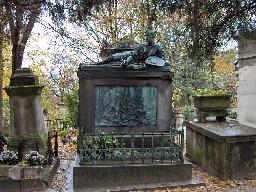 The grave of Théodore Géricault at Père Lachaise, Paris. Picture by Androom (19 Nov 2006) |
Sources • Théodore Géricault - Wikipedia (EN) |


